Is it Technique or Skill?

The best part of social media is the sharing of information. In football coaching circles this traditionally becomes an exercise of watching film, isolating techniques or movement patterns, and giving a couple coaching cues to execute the technique. My question: is technique driving the solution or is it skill?
Here’s the tweet. Okay, so why did the player execute this particular technique instead of the countless other techniques and movement patterns that he has been exposed to throughout his career? Was it because he’s been told 976 times throughout the off-season, fall camp, team meetings, position group meetings, and individual meetings that within an odd front structure, especially 4 open, his mentality pre-snap should be to stack-track-fallback because there is higher probability they are running inside zone. Maybe? Constant feedback is a way to get your point across. And, it has to be one of the most annoying forms of communication (conjecture) and has serious diminishing returns after a while. Additionally, it may overload the athlete with information.
So maybe feedback is part of the answer, but what else? Muscle memory probably plays a role, right? The traditional thought on why techniques in football work is: rote memorization of a desired movement pattern or technique, with enough reps, leads to success on the field. It’s easy to look at a successful outcome and attribute the success of the play to what we “believe” is true and right. However, if he had charged the C gap instead of playing laterally in a shuffle, wouldn’t he have made the tackle closer to the line of scrimmage, resulting in a better outcome?
My belief is the player executed this technique due to the emerging conditions of the play. The technique was the most attractive solution within the environment of this play. The traditional thinking of using proper technique and fundamentals is the wrong direction of causality. Skill is the reason the technique emerged, technique does not make the player skilled. Using the traditional logic that techniques are the answer: couldn’t any kid that can accomplish this specific movement pattern make that play? Are you defining skill as techniques and fundamentals done by the biggest, fastest, strongest players? That doesn’t hold up either, Yuri Verkhoshansky, one of the greatest S&C coaches ever called bullshit on that logic:
“All too often, the solution to most performance problems in such sports seems to be a philosophy of “the greater the strength and the greater the muscle hypertrophy, the better”, despite the fact that one constantly witnesses exceptional performances being achieved in these sports by lighter and less strong individuals.”
Supertraining, pg 20
The players skill doesn’t emerge from command or decontextualized/isolated rehearsed drills. To me, communication and repetition aren’t sufficient answers either. They are reductionist and deterministic. We treat the athlete like a closed system. A system you can wind up and predict, but living things are open systems sitting far from equilibrium, constantly trading energy with their environment. Chemist Ilya Prigogine won a Nobel prize proving that’s exactly where self-organization comes from. Order emerges out of the interaction without anyone scripting it. Dissipative structures.
Defining Skill & Technique
Technique - a physical method or model for accomplishing a task
Skill - potential to solve the current problem
Duarte Araújo on why potential is a critical piece to the definition of skill. Adaptable Athlete Podcast - Why Athletes Don’t Acquire Skill They Adapt It
Fitts-Posner Model of Skill Acquisition
The question remains, how do you train skill? Most coaches unknowingly use the Fitts-Posner model of skill acquisition that theorized, learning progresses through linear stages and early learning is cognitive and rule-based. Skill becomes automated with practice. Information-Processing theories contributed that the brain functions as “computer”, and once info is processed, it “outputs” a behavior. The CNS stores distinct movement patterns to execute the skill.
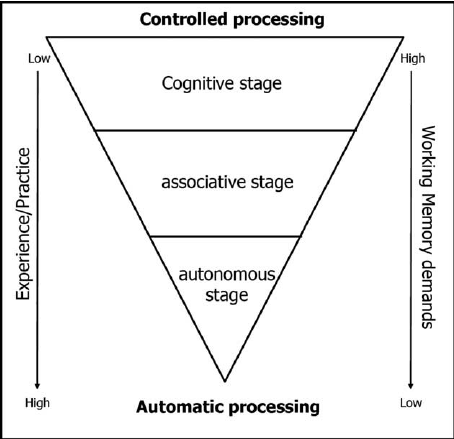
I’m not sure about you, but I personally don’t operate like a computer, nor do I want athletes that move or behave like robots. This does not demonstrate skill. My favorite critique of these informational-processing models was by J.J. Gibson in the Ecological Approach to Visual Perception and the “little man in the brain” theory:
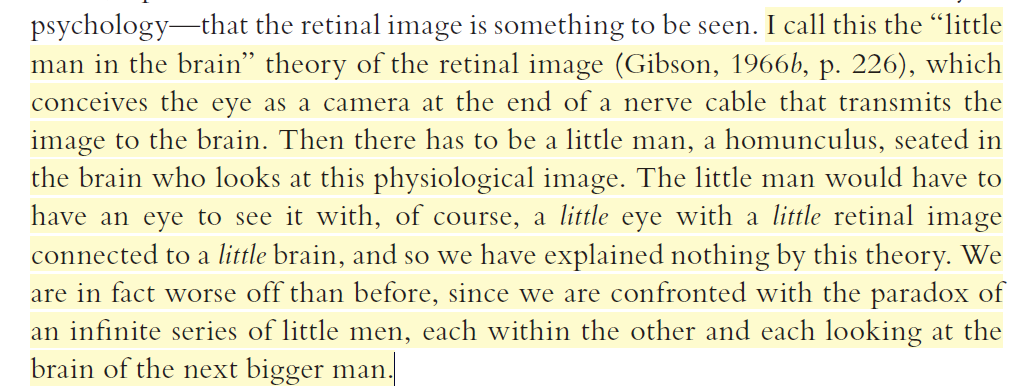
Some may fantasize of being an autonomous dictator, programming information into the athlete’s brain, and maneuvering them like a soulless NPC in the latest edition of Madden. Stripping the athlete of their autonomy does not improve skill. Decomposing skill into an assembly line of techniques leads to drills designed like this 🤮.
In this example, the athlete is decoupled from the environment in which the Stack-Track-Fallback technique emerges. In isolating the movement pattern, we’ve removed the context of stacking the defensive lineman, which is vital for if and when the DL gets cut-out of his gap. The athlete is never going to be on the field with a stationary bag, you are now attuning his perception to an invariant that will never appear on the field of play.
The workspace of the drill is so small that the only tackle occurring in the environment is a frontal tackle. Which on the surface, is fine. For context, Luke Kuechly had a rate of 23% frontal tackles in his career. I charted 776 of his attempts, and 192 were frontal tackles.. So, if you’re training a tackle that happens 1 out of every 5 tackle attempts in a game, it amounts to about 2 tackles a game, if you’re the best player on the field. My point is, we don’t have to simulate the game, it’s too chaotic, but we do have to make it representative. In this example, this drill is not representative of the game of football. How can we expect skill to transfer if we aren’t creating environments that challenge and stress (overload) the athlete?
COMPLEX SYSTEMS
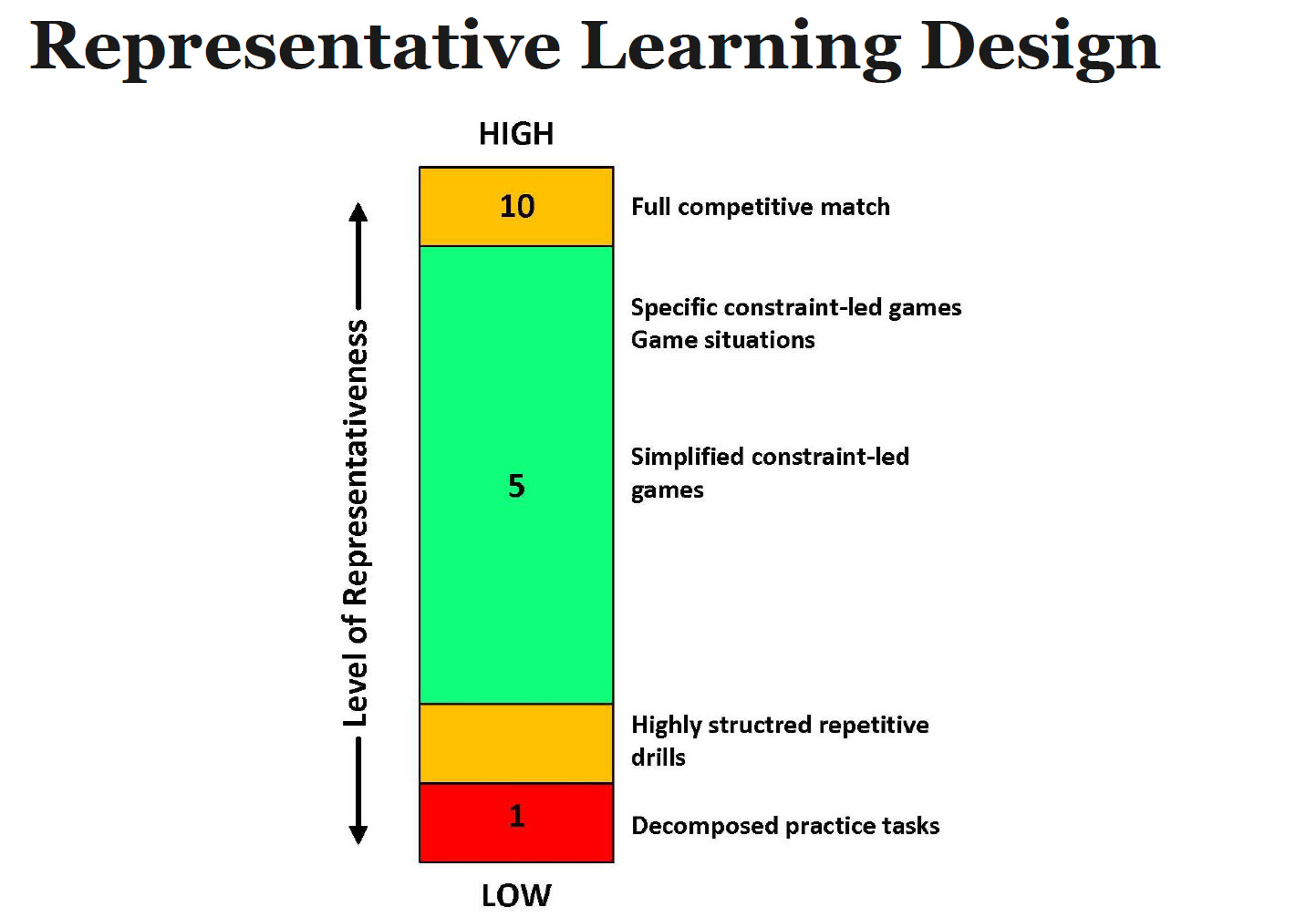
We live in COMPLEX systems not complicated systems. My introduction to complex systems was Manuel Arjona’s book The Nature of Training: Complexity Science Applied to Endurance Performance that I highly recommend. It’s less about endurance performance and more about complex systems and training. Here were a few of my favorite takeaways if you want to check it out.
We confuse living human beings with complicated systems like rockets or cars. Humans can self organize a new pattern of movement if a limb is removed but a car can’t move as soon as one wheel is removed. So lets step back from the reductionist and deterministic coaching principles and embrace the complexity.
CLA & EcoD
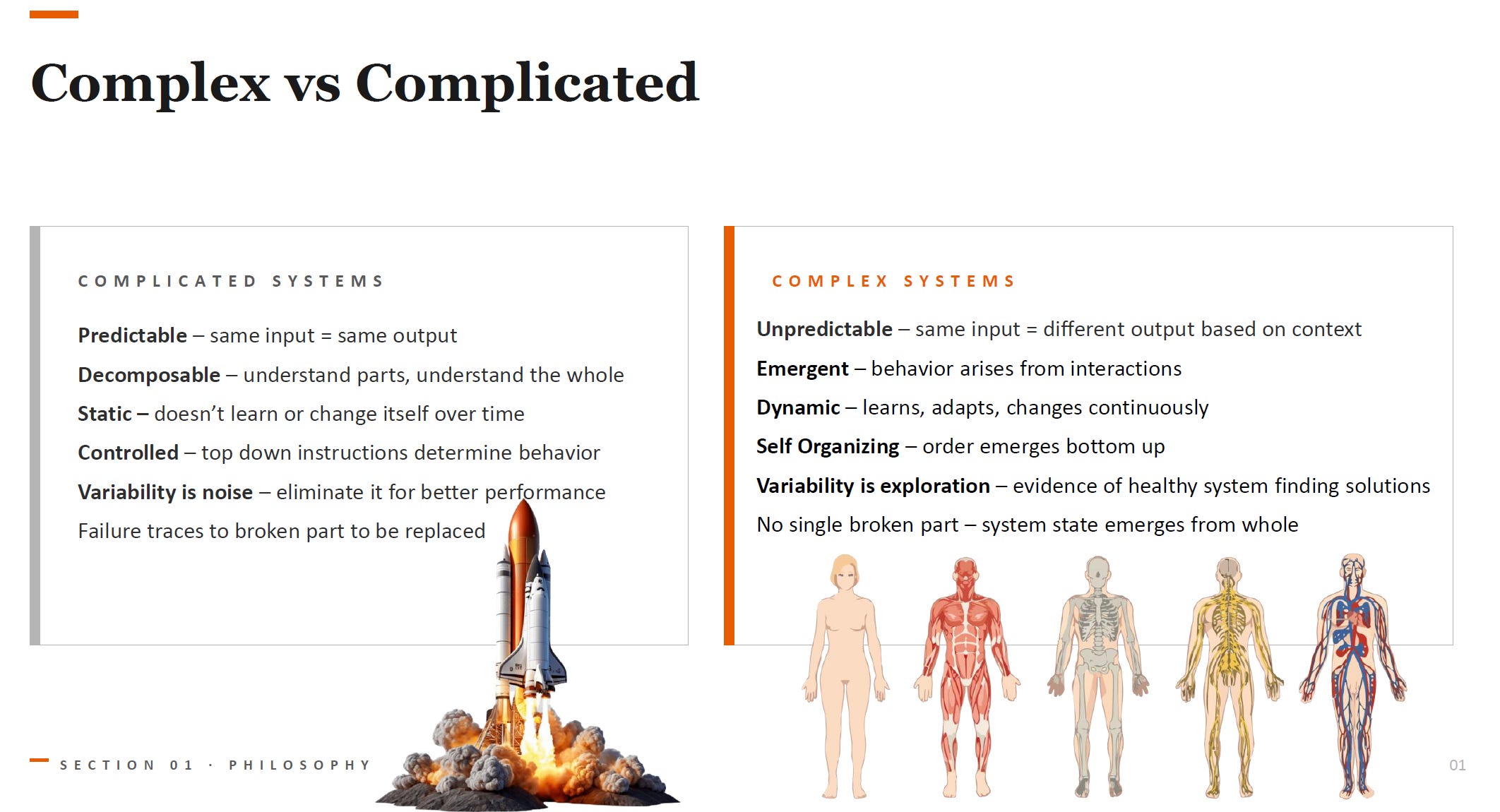
So I ranted about what’s wrong, how would I make it right? Ecological Dynamics is based in complex systems so I would start there and use the principles of the Constraints-Led Approach to create representative designs that keep the athlete-environment relationship in tact.
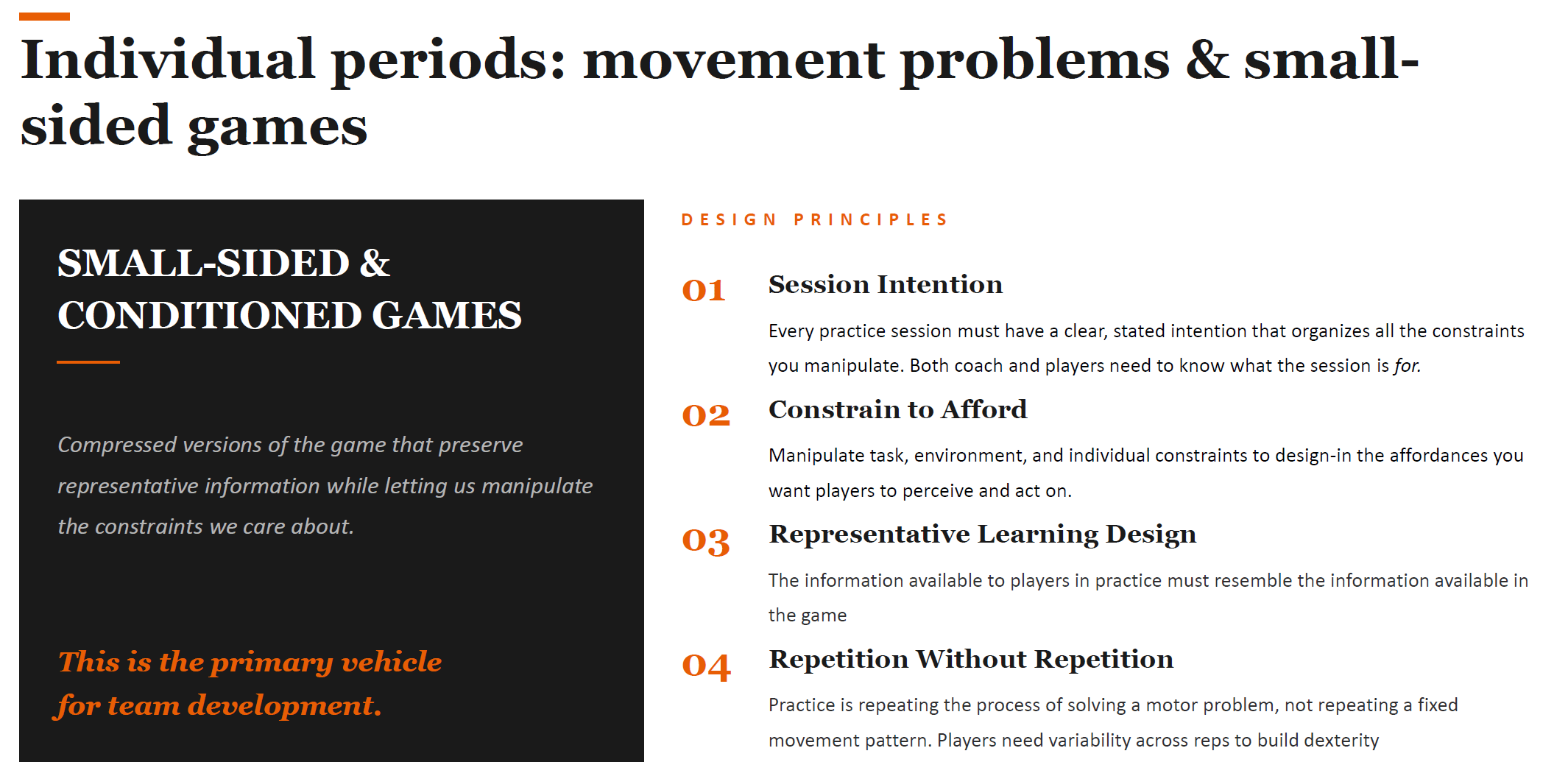
This environment will be representative and keep the problem-solution relationship in tact. This environment will maintain perception-action coupling, continuously picking up information to adjust in real time, rather than following predetermined directions. And, this environment will require authentic and novel problem solving, it will have enough unpredictability and variance to stress the athlete.
Variability is the delivery mechanism for adaptation
Drew Carlson - 2 Razors and Delivery Mechanism for Adaptation as Principle
Everybody understands that in the weight room progressive overload is a key component to becoming a stronger athlete. How do you progressively overload skill? Variability! The static rehearsed drills where athletes are not challenged to perceive what is unfolding in front of them, is the same as solving 2+2 over and over again. Learning is not the process of repeating a solution, it is the process of finding a solution.
ATTRACTOR STATES
Complexity and variability don’t sound conducive to stability, so how do we get any stability in our techniques? Attractor states. So what's an attractor state? It’s a stable pattern the athlete-environment system keeps settling into when the conditions pull it that way. In the first clip the most stable pattern for that particular player was to stack and shuffle. Under those exact conditions it was the most attractive, most stable solution so the system self-organized into it without him thinking about it. The pattern emerges from the interaction, it isn’t stored anywhere waiting to be executed. Within complex systems stable states emerge, like birds in a flying V. Nobody taught them the most economical, efficient way to fly, it emerged through their interaction with the environment. Cool study and video on attractors below.
Hristovski et al. (2006): boxers punching a heavy bag at different distances showed that which punch emerged (jab, hook, etc) was dictated by the boxer-target distance. The in-between distances were the creative zone, where multiple punches coexisted as competing attractors and the same boxer self-organized into different solutions from tiny changes in distance.
FIXING THE “DRILL”
The definition of drill - to fix something in the mind or habit pattern by repetitive instruction. Let’s redefine it as an activity.
So here’s how I would approach an activity that allows the athlete to find a solution. Create a workspace big enough for variation to occur. It should be big enough to allow multiple solutions. A bigger space allows something outside zone-esque to emerge which is a possibility on any snap of the game (remember variability is good). Create an OL/DL dyad with set intentions. Whether its to stay fitted up the entire time to introduce the concept or its a true primary/secondary gap situation to enhance the representativeness of the activity. Set win conditions in the activity. For example, the ball carrier wins by making it to through the end of the workspace. The defense wins by stopping the ball carrier before the end of the workspace. Setting win/loss conditions can clear up scout look problems that occur during indy. Something like this.
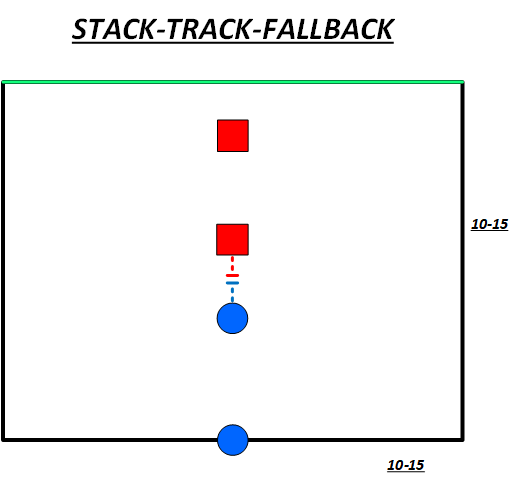
Now imagine this, the runner keeps choosing an outside path. Variability is good but in this case maybe its too much. Especially if we are introducing the concept. Poor design but we can fix it. Constrain the activity to afford what you’re looking for.
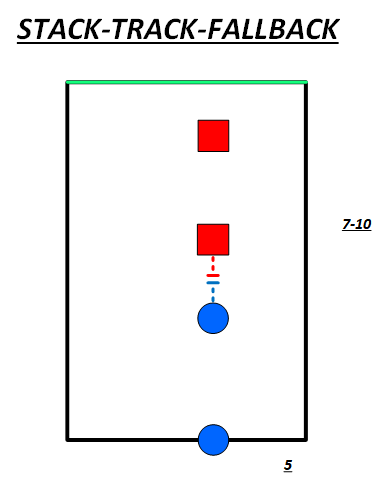
The workspace has been reduced and now affords more interplay of the OL/DL dyad with the ball carrier. This is what happens in the first clip. The ball carrier can still attack the perimeter to the left, and cut it back, as we saw. The difference is, the ball carrier can no longer exploit the space to the right. You’ve now experimented and designed an activity that adapts the skill ;)
"Perceiving gets wider and finer and longer and richer and fuller as the observer explores the environment."
J.J. Gibson, The Ecological Approach to Visual Perception (Classic Edition), p. 244.
Conclusion
So the final answer? The solution emerges from the athlete-environment interaction, not from a technique being recalled by the little man in the brain. Skill is the capacity to find that solution, technique is just what it looks like after the fact. So stop drilling techniques in isolation and start designing environments that make the athlete solve. Adapt skill.
Banger